

NZ Diploma in Construction (Quantity Surveying)
- Level
- Level 6
- Duration
- 2 years full-time
- Intakes
- February, April, July, October
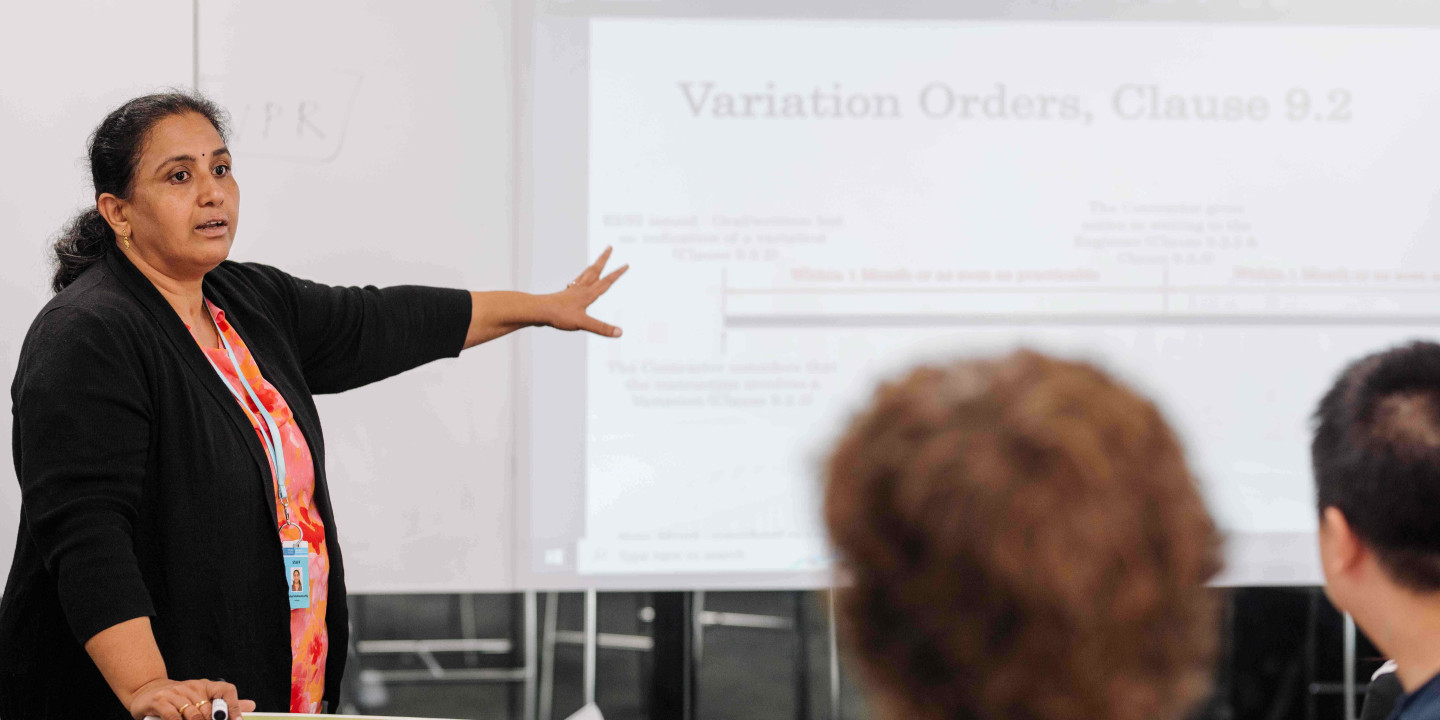
Want to kickstart your career in quantity surveying?
Gain real-world technical skills in budgeting and cost planning for construction projects in this hands-on learning programme.
The New Zealand Diploma in Construction is recognised by employers and industrial, academic and professional bodies - so when you graduate, you'll be highly competent and industry-ready.
-
What will I learn?
Cost Estimation
You will learn to analyse and present feasibility information and preliminary estimates to clients. You will be able to assemble quantity surveying documentation relevant to specialist and specific trade sections and measure a schedule of quantities for a small building of an individual trade section including services.
Regulatory Environment
You will develop an understanding of the roles, standard documentation and administrative requirements of the construction industry. You will learn to operate within the statutory and regulatory environment as it applies to the construction and design of buildings.
Project Management
You will learn how to manage construction and resource allocation, programming and construction activities, for medium and large buildings. You will know how to evaluate and select materials and finishes for building projects, taking into account environmental aspects of the design and construction techniques to be used. You will be able to analyse, select and administer construction contracts including the preparation of a tender submission from trade sections and other financial components and value building works up to and including final account statements.
Construction Technologies
You will gain knowledge of structure and structural principles for building work including foundations, substructure, the envelope and the interior, and passive fire protection systems for medium and large buildings.
You will learn to use the following software:
- QV Cost Builder
- Cost X
- MS Project
- Excel
You will study
You will study a total of 240 credits.
Courses Year 1 (Compulsory)
Course
Description
Level
Credits
Introduction to Construction Studies
Develop knowledge and skills related to construction roles, responsibilities, documentation and communication.
5
15 credits
Material and Structural Principles
Develop knowledge and skills of structural principles and the properties of materials and finishes applicable to building projects.
5
15 credits
Law and Construction Contracts
Develop knowledge of Aotearoa New Zealand legislative and regulatory frameworks and to relate these frameworks to professional practice within a construction and consulting environment.
5
15 credits
Construction 1 Residential
Develop and apply knowledge and skills related to structures, building envelope and the interior for a small building.
5
15 credits
Services
Develop knowledge and skills relevant to the purpose, operating principles, coordination, and legislative requirements required to manage a range of services in small, medium, and large buildings.
5
15 credits
Construction 2 Commercial
Develop the knowledge and skills to select and incorporate foundation methods, structural systems, building envelope and the interior for medium and large buildings.
6
16 credits
Environment
Develop knowledge and skills to evaluate site and building limitations including environmental impacts and sustainable methods of construction.
5
15 credits
Introduction to Measurement and Estimation
Develop the knowledge and skills to measure and estimate costs for inclusion in tenders for small building projects.
5
15 credits
Courses Year 2 (Compulsory)
Course
Description
Level
Credits
Measurement 1
Develop the knowledge and skills to assemble quantity surveying documentation and measure schedules of quantities for a small building project.
5
15 credits
Estimation
Develop the knowledge and skills to estimate costs for inclusion in tenders for medium and large building projects.
5
15 credits
Programming
Develop the knowledge and skills to effectively programme and monitor activities, resources and contingencies for a medium building.
6
15 credits
Measurement 2
Develop the knowledge and skills to assemble and measure schedules of quantities from project information for medium and large buildings.
6
15 credits
Financial Administration
Develop the knowledge and skills to analyse and conduct a valuation and prepare account statements for work carried out on a construction site.
6
15 credits
Procurement
Develop knowledge and skills relevant to a range of procedures, types of contracts, methodologies and processes for the procurement of building projects.
6
15 credits
Cost Planning
Develop the knowledge and skills to analyse and prepare preliminary estimates, elemental cost plans and preliminary cashflow statements for medium and large building projects.
6
15 credits
Regional Project Quantity Surveying
Develop the knowledge and skills to act as quantity surveyors by studying selected aspects of regional construction practice, emerging construction technologies and professional practice.
6
15 credits
-
What are the entry requirements?
Academic requirements
-
NCEA Level 2, including mathematics.
-
NCEA Level 1, including literacy.
-
Or a relevant qualification at NZQCF Level 4 OR above.
-
Or be able to demonstrate equivalent knowledge and skills.
International requirements and equivalence
To enter our undergraduate certificates, diplomas and degrees, you need to have achieved a secondary school qualification that is equivalent to New Zealand's NCEA levels (National Certificate of Educational Achievement).
This information is available by country on our Equivalent academic entry requirements page.
If English is not your first language, you must provide:
- New Zealand University Entrance, OR
- Overall Academic IELTS 6.0 with no individual band score lower than 5.5 (achieved in one test completed in the last two years), OR
- Acceptable alternative evidence of the required IELTS (see here for NZQA proficiency table).
We do not accept international learners under the age of 18 at the time of enrolment.
-
-
What's the weekly workload?
You need to dedicate about 35 hours per week to the programme.
-
What could I study next?
Bachelor of Construction degree.
-
What should I know about the industry?
Gain in-demand skills to enter one of the fastest-growing industries in New Zealand.
Better payAccording to NZ Talent.com, the average salary of quantity surveyors in New Zealand is $100,000. Entry-level positions start at about $74,000 per year and soar to up to $144,000 per year for experienced workers.
High job prospects
Construction is the fifth largest sector in New Zealand’s economy, employing just over a quarter of a million people. Around 4,800 new jobs a year will be created in construction in the years to 2028, according to the government’s medium to long-term employment outlook.
The skills of Quantity Surveyors are highly sought-after in New Zealand – as there are quantity surveyor shortages throughout the country, and demand is growing.
Auckland represents over a third of New Zealand's construction activity, especially for its extensive housing projects. However, there are opportunities elsewhere including various roading projects, Christchurch's rebuild, and Wellington's earthquake strengthening, ensuring there are plenty of opportunities all over New Zealand.
International Students
Quantity surveyors are on New Zealand’s skill shortage lists, so if international graduates have a full-time job offer – and the right experience and qualifications – it may be easier to apply for a visa.
Source: Immigration NZ
Career outcomes
This programme can lead to successful careers as Estimators, Consultants, Contract Administrators, Contract Managers and Junior Quantity Surveyors.
Other programmes
-
Business

Bachelor of Applied Management
NZQA Level 7 3 years full-timeFees: $23,400 (first year) After Scholarship: $23,100 (first year) -
Business

Bachelor of Applied Management
NZQA Level 7 3 years full-timeFees: $23,900 (first year) After Scholarship: $19,400 (first year) -
Construction
Bachelor of Construction (Quantity Surveying)
NZQA Level 7 3 years full-timeFees: $26,572 (first year) After Scholarship: $23,100 (first year)